Signal

Issue #19 · 2026-W30


This week in Signal

Merging Different-Sized LLMs by Simple Weight Averaging Actually Works

Jiahe Fan, Yinghao Hou, Si Chen, Aiyuan Zhang, Hong Xie, Defu Lian

Large language models of different sizes can be merged by direct weight averaging — no training, no alignment — and sometimes the result outperforms both source models.

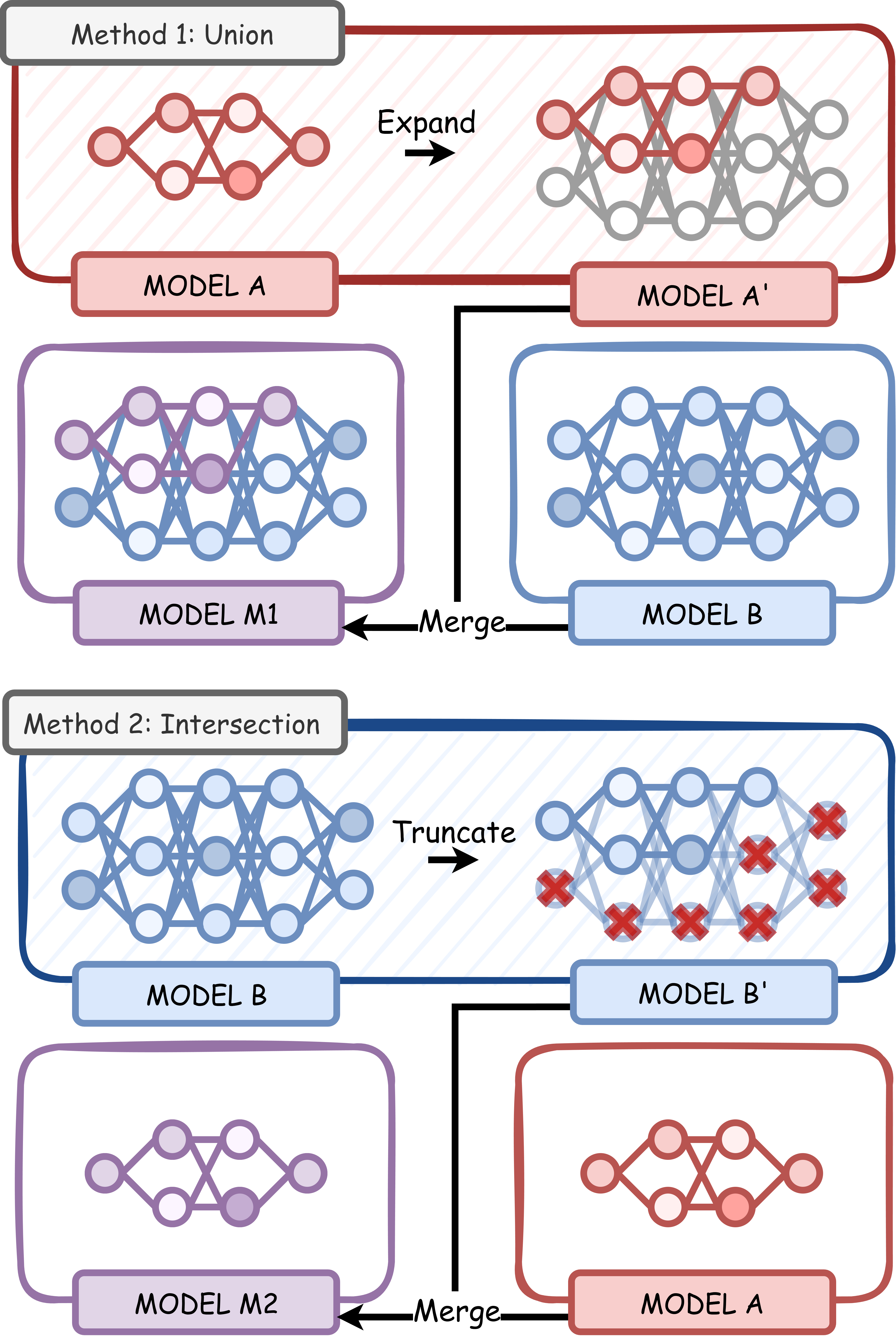
Two heterogeneous model merging strategies.

The Problem

Model merging — combining the weights of two trained models into one — has become a popular way to create capable LLMs without expensive retraining. But nearly all successful merging techniques assume the source models are *homogeneous*: same architecture, same parameter shapes, same internal layout [§1]. Methods like weight averaging, task arithmetic, and TIES-Merging all require this structural compatibility [§2].

Real model pools don't cooperate. They contain checkpoints of different scales, specializations, and designs [§1]. A 3-billion-parameter model and a 32-billion-parameter model don't even have tensors of the same shape — you can't average what you can't align. Existing solutions for this *heterogeneous* merging problem typically bolt on significant complexity: knowledge distillation, trained adapters, learned latent spaces, routing modules, or explicit feature alignment [§1, §2]. Each of these works, but each also undermines the core appeal of model merging as a fast, training-free operation.

This raises a pointed question: can you skip all that machinery and just average the weights directly, after making the shapes match?

What They Did

The researchers tested the simplest possible approach to merging LLMs of different sizes. The procedure has two steps: dimensional adaptation (making the parameter shapes compatible) and ratio-controlled interpolation (weighted averaging with a tunable mixing coefficient) [§1].

For dimensional adaptation, they defined two strategies [Abstract, Figure 1]. In **union-style merging**, the smaller model is expanded into the larger model's parameter space. Concretely, the smaller model's existing weights are copied over, and the new dimensions — extra attention heads, wider MLP layers, additional transformer layers — are initialized to zero (for computation branches) or one (for normalization scales), so the expanded model initially behaves identically to the original smaller model [Figure 2a]. Think of it as giving the smaller model a bigger house where all the new rooms are empty.

In **intersection-style merging**, the larger model is truncated into the smaller model's parameter space. Oversized weight matrices are sliced to keep only the dimensions that fit, and layers beyond the smaller model's depth are dropped entirely [Figure 2b]. This is lossy — you're projecting a richer representation into a smaller container.

After dimensional adaptation, the two now-compatible models are merged by weighted averaging: `merged = (1 - α) × base + α × adapted`, where α controls how much of the adapted model's weights are mixed in [§1]. The entire procedure requires no fine-tuning, no distillation data, no adapters, no routing module, and no learned encoder [§1].

All experiments used Qwen-family model pairs (e.g., Qwen2.5-3B with Qwen2.5-32B, or Qwen2.5-14B with Qwen2.5-32B) across benchmarks covering mathematical reasoning, code generation, language understanding, commonsense reasoning, knowledge, and instruction following [Abstract].

The Results

The headline finding: this deliberately simple method can produce merged models that outperform both source checkpoints. In union-style merging between Qwen2.5-14B and Qwen2.5-32B, the two source models scored 0.7044 and 0.7424 on average across benchmarks, while the best merged model reached 0.7525 [§1]. In intersection-style merging, Qwen2.5-3B improved from 0.5459 to 0.5716 when a truncated 32B branch was injected with a small coefficient [§1].

Two critical caveats emerged. First, the mixing ratio matters enormously. Small values of α (injecting a little of the adapted model) can transfer complementary capabilities, but near-balanced interpolation (α ≈ 0.5) often causes performance collapse [Abstract]. The method works in a narrow "effective region" of the mixing ratio, not across the full interpolation range.

Second, task-level results reveal a **seesaw effect**: gains on some capabilities coexist with regressions on others [Abstract, §1]. The merged model doesn't uniformly improve — it redistributes capability. A model that gains on math reasoning might lose ground on code generation. This means aggregate scores can mask real degradation on specific tasks.

Deterministic expansion (the union-style dimensional adaptation step alone, before any merging) largely preserves the source model's function [§1]. This is itself a useful finding: you can inflate a smaller model into a larger parameter space without breaking it, which validates the dimensional adaptation as a functional bridge rather than just a shape-matching hack.

The experiments are limited to the Qwen model family [Abstract]. Models from different families (say, Llama and Mistral) would have more divergent internal representations, and the paper does not test whether the approach transfers. The seesaw effect also means there's no free lunch: practitioners would need task-specific evaluation to determine whether a merge actually helps for their use case.

Why It Matters

For builders working on model merging pipelines, these results establish a concrete lower bound. Before investing in distillation, adapter training, or learned alignment modules for heterogeneous merging, it's worth checking whether simple dimensional adaptation plus small-ratio averaging already captures the gains you need [§1]. The procedure is trivial to implement and costs nothing beyond inference-time evaluation.

For decision-makers evaluating model consolidation strategies, the seesaw effect is the critical takeaway [Abstract]. Merging heterogeneous models isn't a reliable way to get "the best of both" — it's a tradeoff that requires task-level auditing. The paper's broader implication is that the failure modes of simple weighted averaging may represent fundamental compatibility limits that even sophisticated methods cannot easily bypass [§1]. If direct interpolation collapses at balanced ratios, that collapse likely reflects genuine representational incompatibility between the source models, not just a limitation of the averaging technique. This reframes the value proposition of complex heterogeneous merging methods: they need to demonstrate gains *beyond* what this simple baseline achieves, in the regimes where it works, and *recovery* in the regimes where it collapses.

Aligning Financial AI Retrieval with How SEC Filings Actually Work

Jijun Chi, Zhenghan Tai, Hanwei Wu, Tung Sum Thomas Kwok, Hailin He, Zixing Liao, Bohuai Xiao, Chaolong Jiang, Jianliang Lei, Jerry Huang, Peng Lu, Muzhi Li, Liheng Ma, Yihong Wu, Sicheng Lyu, Jingrui Tian, Yihan Li, Yanzhang Ma, Dingtao Hu, Yufei Cui, Ling Zhou, Lei Ding, Xinyu Wang

A multi-agent system that conditions its search queries on the actual structure of SEC filings outperforms existing financial QA approaches across five benchmarks and a 1,000-person user study.

Why now: from a top lab.

The Problem

SEC filings like 10-Ks are long, highly structured, and full of near-duplicate boilerplate. A company's risk factors section might use language almost identical to dozens of other issuers, while the genuinely material disclosures are buried in specific subsections. When an analyst asks whether a company's expansion is sustainable, the answer requires pulling together numerical data from financial statements, narrative context from management discussion, and risk disclosures — evidence scattered across different parts of the filing [§1].

Existing retrieval-augmented generation (RAG) systems typically derive search queries directly from the user's question and rank retrieved chunks by semantic similarity. The paper identifies a specific failure mode it calls "prior–corpus misalignment": the model generates queries based on what it thinks relevant evidence should look like, rather than how evidence is actually written and organized in the filings [§1]. This creates problems at both ends of the pipeline. At the front end, queries miss genuinely disclosed material because they don't match the filing's terminology. At the back end, semantic reranking promotes boilerplate that sounds relevant but isn't — generic compliance language that scores highly yet says nothing specific about the company in question [§1].

What They Did

FinSAgent addresses this misalignment with three interlocking mechanisms [§3.1].

**Role-specialized parallel agents.** Instead of a single search trajectory, five agents simultaneously analyze each question from different angles: general, quantitative, market, legal, and company. Each agent is mapped to specific sections of the mandated 10-K item structure — for example, the quantitative agent targets Items 8 and 7A (financial statements and quantitative disclosures), while the legal agent focuses on Items 1A and 3 (risk factors and legal proceedings) [Table 1, §3.2]. Think of it as assigning five analysts with different specialties to the same question, each knowing exactly which filing sections to search.

**Database-aware query decomposition.** This is the core mechanism for fixing the front-end misalignment. Before generating search queries, each agent is shown a lightweight summary of the actual filing database — compact summaries of contiguous filing chunks, retrieved via a FAISS index [§3.3]. Rather than asking "what would relevant evidence look like?" based on the model's training data, each agent asks "what does this specific filing actually contain that might be relevant?" The summaries act as a coarse map of the corpus, grounding query generation in the filing's real structure and vocabulary.

**Feature-gated reranking.** To fix the back-end problem, FinSAgent uses multi-path retrieval (combining dense vector search and sparse keyword matching) followed by a learned reranker that incorporates non-semantic features alongside semantic similarity [§3.4]. The gate mechanism down-weights chunks that look topically relevant but fail validity checks — separating "this text is about the right topic" from "this text is actual evidence for this specific company's situation."

An orchestrator routes each question to the relevant agents and aggregates their outputs into a final grounded answer [§3.1].

The Results

FinSAgent achieves the highest answer correctness on all five offline financial QA benchmarks tested, outperforming both single-agent RAG pipelines and multi-agent baselines under matched evidence budgets [Abstract, Figure 1]. The baselines include Naive RAG (with and without BM25), FinSage, FinGPT, a mixture-of-agents design, and FinDebate [Figure 1].

In a three-arm randomized online experiment with approximately 1,000 anonymous user ratings, FinSAgent also received higher scores than baselines [Abstract]. The paper reports a broader set of ~1,400 anonymous user ratings supporting these results [§1].

The paper's retrieval analysis indicates that role specialization provides complementary coverage — the different agents retrieve evidence from distinct filing sections that a single-agent approach would miss [§3.2]. This validates the design choice of mapping agents to the 10-K item structure rather than using generic role definitions.

Several limitations deserve attention. The agent roles are derived from the 10-K structure specifically; filings with different structures (non-U.S. regulatory filings, proxy statements, 8-Ks) would require redesigned role mappings. The system uses Qwen3-Max as its backbone [Figure 1], and performance with other foundation models isn't reported. The online experiment, while randomized, involved anonymous ratings without detailed disclosure of rater expertise or question difficulty distribution. For practitioners considering deployment, the key question is whether the corpus-alignment principle transfers to their specific document types and whether the inference cost of running five parallel agents is acceptable for their latency requirements.

Why It Matters

For builders working on financial document QA, the most transferable insight is the diagnosis, not just the solution. The prior–corpus misalignment framing [§1] gives a concrete name to a failure mode that likely affects any RAG system operating over highly structured, boilerplate-heavy corpora — legal contracts, regulatory filings, clinical trial documents. The specific fix of conditioning query generation on corpus summaries rather than relying solely on the user question is implementable with existing tools (FAISS indexing of section summaries is lightweight) and testable against current pipelines.

For decision-makers evaluating AI tools for financial analysis, this work demonstrates that the retrieval strategy matters as much as the underlying language model. If your team's financial QA system surfaces generic boilerplate instead of company-specific disclosures, the problem may not be the model — it may be that search queries aren't aligned with how the filings are actually organized. The dataset and framework details are described in the paper, though the code availability status is not explicitly stated in the sections reviewed.

Tiny AI Models Debate Each Other to Reason Better

Martino M. L. Pulici, Cuong Xuan Chu, Evgeny Kharlamov, Zifeng Ding, Volker Tresp, Yunpu Ma

A 1.5-billion-parameter model gains 2 percentage points on math reasoning by training separate "generator" and "critic" agents that debate — using 16× fewer trainable parameters than full fine-tuning.

The Problem

Multi-step mathematical reasoning is hard for language models under 4 billion parameters [§1]. Scaling up model size helps, but the training and inference costs are prohibitive for many real-world deployments [§1]. Two strategies have emerged to compensate: reinforcement learning (RL) to fine-tune reasoning behavior, and test-time techniques like multi-agent debate where multiple model instances cross-check each other's answers [§1].

But combining these strategies has been expensive. Prior attempts to integrate RL with debate involve "significant computational overhead or architectural complexity" [§1]. Full-model fine-tuning is the norm, credit assignment between debating agents is unstable, and test-time deliberation is underused during training [§1]. The question is whether you can get the benefits of both — RL-trained reasoning and multi-agent debate — in a package small enough to run on constrained hardware.

What They Did

MADA-RL splits a single compact model into two specialized roles: generators that produce initial answers, and critics that review and revise those answers across multiple debate rounds [§2]. Rather than training entirely separate models, each role is implemented as a lightweight LoRA adapter — a small set of trainable parameters bolted onto a frozen base model. Think of it like giving the same employee two different job descriptions and two small specialized toolkits, rather than hiring two full employees [§3.1].

The training happens in two stages [§3.1, Algorithm 2]. First, generator agents are trained independently on disjoint data subsets using GRPO, a reinforcement learning method that doesn't require a separate value model. Each generator learns to produce correct, concise answers, with a reward function weighted 2:1 in favor of accuracy over brevity [§3.2].

The key innovation is in how critics are trained. The researchers construct a debate-aware dataset: for each training problem, all generators produce answers, and those answers are concatenated with the original question to form the critic's input [Algorithm 2, lines 6-12]. The critic then trains with what the authors call a "counterfactual critic advantage." Instead of the standard RL baseline (how well did you do on average?), the critic's baseline is the generator ensemble's per-instance accuracy on that specific problem [§3.3, Abstract].

In concrete terms: if three out of four generators already got a problem right (75% accuracy), the critic gets rewarded only for doing better than that 75% threshold. If all generators failed, the bar is lower. This means critics are explicitly optimized to fix mistakes the generators make, not to parrot correct answers that were already available [Abstract].

At inference time, the specialized agents run a multi-round protocol: generators answer first, then critics revise over subsequent rounds, with the final-round answers determining accuracy [§2, Algorithm 1].

The Results

Across five mathematical reasoning benchmarks, MADA-RL raises the average accuracy of DeepSeek-R1-Distill-Qwen-1.5B from 39.9% to 41.9% — a 2.0 percentage point gain with p < 0.001 [Abstract]. This is achieved while training 16× fewer parameters than fully fine-tuned baselines [Abstract].

The method places on the accuracy-versus-trainable-parameters Pareto front, meaning no other evaluated method achieves the same accuracy with fewer trainable parameters, or higher accuracy with the same count [Abstract]. However, the authors are direct about the ceiling: MADA-RL "approaches, but does not surpass, the strongest baselines (DeepScaleR, Still-3), which are trained on substantially larger datasets" [Abstract].

A controlled ablation study isolates where the gains come from. The counterfactual advantage produces "the highest critic improvement rate of any model evaluated," meaning trained critics learn to correct generator errors rather than imitate them [Abstract]. This matters because it rules out a simpler explanation — that gains come merely from running more inference passes at test time. The debate structure helps, but the training signal is what makes critics genuinely corrective [§1].

The limitations are concrete. The evaluation covers only mathematical reasoning benchmarks; generalization to code, science, or open-ended reasoning is untested. The multi-round debate protocol adds inference-time cost — more tokens generated per query — which the authors acknowledge and analyze directly [Abstract]. And the accuracy gap to models trained on larger datasets suggests that data scale remains a bottleneck that architectural cleverness alone cannot close.

Why It Matters

For engineers working with small models under compute constraints, MADA-RL demonstrates a specific, reproducible pattern: you can split a single base model into role-specialized agents via LoRA adapters and train them with role-aware rewards to get reasoning improvements without scaling model size or training data. The counterfactual advantage idea — baselining a critic against the ensemble it's meant to improve — is a technique that could be extracted and applied to other multi-agent setups beyond math reasoning.

For decision-makers evaluating whether to invest in larger models or smarter training of smaller ones, the result is informative but bounded. A 2-point accuracy gain is real and statistically significant, but the gap to models trained on larger datasets persists [Abstract]. The inference cost of multi-round debate also needs accounting in any deployment budget. The takeaway is not "small models are now sufficient" but rather "the ceiling for small models is higher than previously demonstrated, if you're willing to pay in inference tokens instead of training compute."

A Simple Training Recipe Catches AI-Edited Image Regions Across Models

Yi Tang, Xinyi Shang, Jiacheng Cui, Sondos Mahmoud Bsharat, Jiacheng Liu, Xiaohan Zhao, Tran Dinh Tien, Ahmed Elhagry, Salwa K. Al Khatib, Tianjun Yao, Yonina C. Eldar, Jing-Hao Xue, Hao Li, Salman Khan, Zhiqiang Shen

A training framework using just 19.2% of the original dataset outperforms prior methods by over 26% at localizing tampered pixels across unseen AI models.

The Problem

Modern AI models — ChatGPT, Gemini, Qwen-Image, and others — can now edit specific regions of an image so convincingly that detecting the manipulation requires identifying the exact tampered pixels, not just flagging the image as fake [§1]. The challenge is that each model leaves different fingerprints. A detector trained on edits from one model tends to overfit to that model's specific artifacts and fails when it encounters edits from a different or newly released model [§1].

The prior best method, PIXAR, trains on data from a single generator (Qwen-Image) and derives supervision from per-pixel differences between original and edited image pairs [§2]. But it leaves cross-generator robustness largely unexplored [§2]. This matters because in practice, you don't know which AI model produced a suspicious image — and new models appear constantly.

The authors frame this as a domain generalization problem: can you train a tampering detector on some set of AI models and have it work on models it has never seen [§1]?

What They Did

The framework, called PIXAR-DG, builds on an existing VLM-based detector architecture that jointly predicts three things: a pixel-level tampering mask (which exact pixels were edited), a semantic label (what object was changed), and a natural-language description of the tampering [§3.1]. The detector is trained with five losses covering these tasks [§3.1, Equation 6].

The core contribution is not a new architecture but two training strategies.

**Balanced minibatch sampling.** In typical tampering datasets, manipulated images vastly outnumber real ones. Naive uniform sampling means most training batches are dominated by tampered images, which biases the model toward tampering-specific artifacts and away from learning what clean images look like [§3.2]. The fix is straightforward: each minibatch is constructed with a fixed ratio ρ of real to tampered images, so every optimization step sees a controlled mix of both [§3.2, Equation 11-12]. Think of it like ensuring a medical training dataset always shows a doctor both healthy and diseased tissue in every study session, rather than letting one category dominate.

The authors report that without this balancing, they "frequently observe" training collapse — the model degenerates and stops learning useful features [Abstract, footnote 1].

**Late injection.** When a new AI model appears, you might only have a small number of its edited images. Mixing these scarce samples into training from the start can cause the model to overfit to them or let them distort early feature learning [§3.3]. Instead, the detector first trains on a large base dataset (e.g., Qwen-Image edits) until convergence, and only then is a small set of new-domain data (e.g., Gemini-2.5 edits) injected alongside the base data at a reduced learning rate [§3.3, Equations 15-16]. This is analogous to teaching someone the fundamentals of a subject before introducing edge cases — the foundation stays stable while the model adapts to new patterns.

A third component is a low-learning-rate schedule during the injection phase, which prevents the small new-domain data from overwriting what the model already learned [Figure 1].

The Results

The method was evaluated on four out-of-distribution VLMs that the detector never saw during training: GPT-Images-2.0, Gemini-3.1, FLUX.2, and Seedream 4.5 [Abstract]. Compared to PIXAR, the prior best method, PIXAR-DG achieves 26.1% relative improvement in average gIoU and 26.8% relative improvement in average cIoU across these four unseen models [Abstract]. These are metrics that measure how well the predicted tampering mask overlaps with the actual edited region — higher is better.

Critically, this performance comes from using only 19.2% of the original PIXAR dataset scale [§1]. The method consistently improves across all new domains, not just some [§1].

The balanced sampling strategy proves essential: without it, training collapse is a recurring problem [Abstract, footnote 1]. The ablation confirms that both components — balanced sampling and late injection — contribute to the gains, rather than one carrying all the weight.

**Limitations.** The evaluation covers four OOD models, which is a meaningful but limited test of generalization. Real-world tampered images may involve multiple editing passes from different tools, human touch-ups, or compression artifacts — none of which this controlled setup tests [§1]. The base architecture still requires paired original-edited images for supervision during training [§2], which limits applicability to scenarios where such pairs aren't available. The framework is validated on the PIXAR benchmark specifically; how well these strategies transfer to other detector architectures or entirely different forensic tasks remains undemonstrated.

Why It Matters

For builders working on content-authenticity or forensic detection systems, the practical takeaway is that training strategy may matter as much as model architecture or dataset size. Balanced sampling and staged data injection are both simple to implement on top of existing segmentation-based detectors — the code is public at the linked repository [Abstract]. If you're already training tampering detectors, these are low-cost experiments to run.

For decision-makers evaluating AI-generated content risks — in newsrooms, platforms, or trust-and-safety teams — this work demonstrates that cross-model generalization in tampering detection is feasible without needing training data from every new AI model that launches. That changes the economics of keeping forensic tools current: you may not need to wait for labeled data from each new generator before your detector can handle it. The gap between controlled benchmarks and production deployment remains significant, but the direction is concrete and the margin of improvement is large enough to warrant attention.

Small LLMs Can Classify Biomedical Ontology Relationships After Fine-Tuning

Tanay Aggarwal, Angelo Salatino, Francesco Osborne, Enrico Motta

Fine-tuning a 9-billion-parameter open-source model achieves 91.6% F1 on biomedical concept relationship classification — a 34-point jump over prompting alone.

The Problem

Biomedical ontologies like MeSH (Medical Subject Headings) organize over 30,000 concepts into hierarchical structures that power PubMed search, clinical documentation, and research analytics [§2.1]. Keeping these systems current is expensive: a systematic survey of 45 research-area ontologies found that 82% are manually curated, demanding substantial time and financial resources [§2.1]. Meanwhile, they lag behind emerging research areas because updates require coordinated expert effort over long periods [§1].

Automated approaches have struggled with the granular complexity of scientific terminologies [§1]. LLMs show promise for ontology generation, but persistent accuracy issues mean they currently function best as assistive tools requiring human-in-the-loop verification [§2.2]. The core question: can small, open-source LLMs — the kind you can run on a single GPU — reliably classify the semantic relationships that form the backbone of these ontologies?

What They Did

The researchers framed ontology construction as a classification problem. Given two biomedical concepts, a model must label their relationship as one of four types: **broader** ("plants" is broader than "agricultural crops"), **narrower** (the inverse), **same-as** ("taste dysfunction" and "taste disorders"), or **other** (unrelated) [§3.1].

To test this, they built **MeSH-Rel-4K**, a dataset of 4,000 concept pairs extracted from the January 2025 release of MeSH [§3.2]. Each relationship category — broader, narrower, same-as, and other — contains 1,000 pairs. The broader and narrower pairs come from MeSH's `broaderDescriptor` property; same-as pairs from its `relatedConcept` property; and "other" pairs from semantically disjoint topics [§3.2]. The dataset was split 70/10/20 into training, validation, and test sets, with concepts strictly isolated across splits to prevent data leakage [§3.2].

They benchmarked five open-source LLMs, all 4-bit quantized: Mistral-7B, Llama-3.2-3B-Instruct, Gemma-2-9B-IT, Phi-3-mini (3.8B), and Zephyr-7B [§3.3]. Each model was tested under three conditions: standard prompting (just asking the model to classify), Chain-of-Thought (CoT) prompting — where the model is instructed to reason step-by-step before answering [§1] — and parameter-efficient fine-tuning using the training split [§1].

The key idea behind fine-tuning here is practical: rather than relying on the model's pre-existing knowledge to reason about biomedical relationships from a prompt alone, you teach it the specific classification patterns by training on labeled examples. All models were small enough to fine-tune on accessible hardware, which matters for teams without large compute budgets.

The Results

Fine-tuning dominated. The fine-tuned Gemma-2-9B-IT achieved an F1-score of 91.6% [§1]. Across all five models, fine-tuning increased the average F1-score by 34.1 percentage points compared to prompting strategies [Abstract]. The most dramatic improvement came from the smallest model: Llama-3.2-3B-Instruct saw a 60.5 percentage point increase in F1 after fine-tuning [§1].

Chain-of-Thought prompting provided only moderate improvements over standard prompting [§1]. This aligns with the paper's observation that parameter-constrained models traditionally struggle with the nuances of in-context logic [Abstract] — asking a 3B-parameter model to "think step by step" about whether "pneumocystis infections" is a subtype of "fungal diseases" doesn't compensate for the model never having deeply encoded that domain structure.

Several limitations deserve attention. The evaluation uses a single ontology (MeSH) in a single domain (biomedicine). The dataset contains 4,000 pairs — substantial for a benchmark but small relative to MeSH's 30,000+ concepts. The four-class setup (broader, narrower, same-as, other) captures the most fundamental ontological relationships but omits more complex semantic structures like part-of or causal relationships. The paper also does not test how these models perform when concepts are ambiguous or when the correct relationship is debatable — situations common in real curation workflows. For decision-makers, this means the approach is validated for clean, well-defined relationships from an established ontology, not for the messy edge cases that consume most of a curator's time.

Why It Matters

For builders working on knowledge organization systems, the practical takeaway is specific: fine-tuning small, quantized open-source models on domain-specific relationship data can yield classification performance above 90% F1, even when prompting alone fails badly [§1, Abstract]. The entire codebase and MeSH-Rel-4K dataset are publicly available [§1], making replication straightforward. If you maintain a biomedical ontology or taxonomy, this provides a concrete starting point for testing whether fine-tuned models can flag candidate relationships for human review — not replacing curators, but reducing the volume of pairs they need to evaluate from scratch.

For decision-makers at publishers, libraries, or research organizations that depend on ontologies for content classification, the finding reframes the cost equation. The paper confirms that direct fine-tuning effectively exceeds the reasoning bottlenecks of smaller LLMs [Abstract], meaning you don't need access to massive proprietary models to get useful results. The 82% of ontologies that rely on manual curation [§2.1] represent a real operational cost; even a partially automated triage step could meaningfully reduce it. But the validation scope — one ontology, four relationship types, controlled conditions — means any deployment would need its own evaluation against the specific ontology and edge cases in question.

Quick Takes

Subscribe — free

AI research, translated. Every week.