Finding Anomalous Pedestrians from Text When Training Data Is Synthetic
A coarse-to-fine retrieval pipeline hits 95.4% mAP@10 matching text descriptions to real-world pedestrian images — trained almost entirely on synthetic data.
- What they did — Built a two-stage retrieval framework that decomposes text queries into semantic facets (appearance, action, objects), retrieves candidates with multiple vision-language models, then reranks a small candidate pool using three parallel expert modules fused by uncertainty-gated consensus.
- Key result — The full pipeline achieves 95.41% mAP@10 on the PAB benchmark, up from 86.44% mAP@10 with the retrieval stage alone and far above the ~60% Recall@1 of zero-shot EVA-CLIP.
- Why it matters — Demonstrates that restricting expensive multimodal reasoning to a small candidate pool makes fine-grained Sim2Real person retrieval practical without requiring the LLM to score every image in a 36,000+ gallery.
The Problem
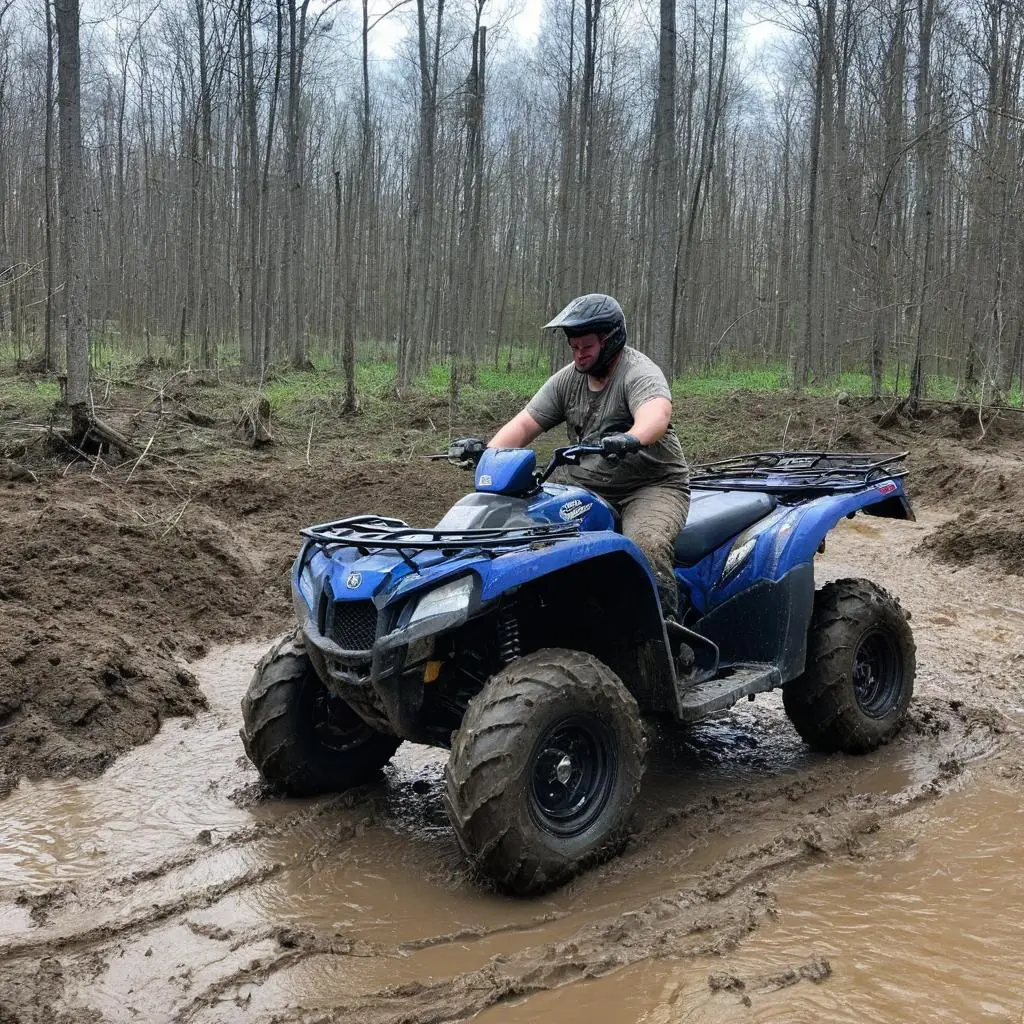
Imagine searching a gallery of 36,773 pedestrian images for one person matching a paragraph-long description: "A person is riding a blue all-terrain vehicle through a muddy trail in a wooded area. The rider is wearing a helmet, a gray shirt, and brown pants..." The target shares clothing, pose, or scene context with thousands of distractors. The difference might be a single action or object interaction [§1].
The Pedestrian Anomaly Behavior (PAB) benchmark formalizes this as *text-based person anomaly search*, where queries describe not just appearance but behaviors like falling or being hit [§1]. Making it harder, models train on over one million synthetic image-text pairs but must retrieve from real-world images — a Sim2Real gap that causes un-adapted models like EVA-CLIP to collapse to roughly 60% Recall@1 in zero-shot mode [§2.1].
Two constraints collide. A single global image-text embedding can miss subtle action or object cues. But running a large multimodal language model over the entire gallery to catch those subtleties is computationally impractical [§1]. The question is how to get fine-grained discrimination without paying fine-grained cost on every image.
What They Did
FaLCon addresses this with a two-stage coarse-to-fine pipeline [§3, Figure 2].
**Stage 1: Multi-view retrieval.** Each text query is broken into semantic facets — appearance, action, object, and scene — plus a full caption and a structured concatenation of all facets [§3.1, Figure 1]. Multiple vision-language retrieval models score the gallery against these different textual views independently. Think of it as asking several specialists the same question from different angles: one focuses on clothing, another on what the person is doing, another on nearby objects.
To prevent a noisy facet (say, an ambiguous action description) from dragging in irrelevant candidates, the system enforces an *anchor constraint*: a candidate image can only enter the pool if at least one of the global caption branches — the "anchors" — also retrieved it [§3.2, Eq. 3]. Facet branches act as soft corrective signals, not independent filters.
Because different retrieval models produce scores on different scales, each branch's scores are normalized per-query using percentile-based scaling and clipped to [-3, 3] to limit outlier influence [§3.2, Eq. 4]. The calibrated scores are then fused with fixed weights, and a reciprocal-rank agreement term rewards candidates that multiple branches rank highly [§3.2, Eqs. 5–7].
**Stage 2: Reranking a compact pool.** Only the top-10 candidates per query advance to the expensive stage. Three parallel expert rerankers score this small pool: a Qwen3 model fine-tuned on PAB data as a discriminative reranker, an anomaly-aware cloze-completion module (which masks key verbs or attributes in the query and checks whether the image can fill them in correctly), and a multi-agent structured verification module inspired by prior detective-analyst workflows [§3, §2.3].
Critically, these experts do not debate or exchange text arguments. Each produces a score independently, and an *uncertainty-gated consensus* module combines them. When the fused prediction is confident, it stands; when uncertain, the module reweights experts based on calibrated reliability [§1, §2.3]. This avoids the known failure mode where debate overturns a correct initial answer — documented at 3.4–5.7% of queries in prior VQA work [§2.3].
The Results
The retrieval stage alone (soft claim-aware fusion without reranking) achieves 86.44% mAP@10 on the PAB benchmark, which the authors describe as substantially outperforming individual retrieval backbones [Abstract]. Adding the three-expert reranking cascade and uncertainty-gated consensus pushes the system to 95.41% mAP@10, 94.44% R@1, and 99.09% R@5 [Abstract, §1].
The R@5 figure is notable: for 99% of queries, the correct image appears somewhere in the top five results. R@1 at 94.44% means the system gets the top-ranked answer right roughly 19 times out of 20.
There are clear limitations. The evaluation uses a single benchmark (PAB) with 1,978 target images and 34,795 distractors [§1]. Real deployments would involve larger, messier galleries where multiple people match partial descriptions. The anchor constraint assumes global caption branches maintain reasonable recall — if the Sim2Real gap degrades those anchors, the entire pipeline's ceiling drops. The reranking stage depends on Qwen3 and multimodal LLM inference, which, while restricted to 10 candidates per query, still requires GPU resources that scale linearly with query volume. The paper does not report latency or throughput numbers.
Why It Matters
For builders working on retrieval systems that must handle fine-grained semantic distinctions — not just "find the person in the red jacket" but "find the person falling off a bicycle near a parked car" — the architectural pattern here is instructive. Decomposing queries into facets and using anchor constraints to prevent noisy facets from corrupting results is a transferable design that doesn't require this specific benchmark [§3.2]. The uncertainty-gated consensus approach to combining multiple rerankers without additional forward passes is worth testing in any multi-expert retrieval stack [§2.3].
For decision-makers evaluating AI-assisted search in surveillance, safety, or forensic contexts: this work demonstrates that Sim2Real transfer — training on synthetic data, deploying on real images — can reach high accuracy on structured benchmarks when paired with the right retrieval architecture [Abstract]. The operative caveat is "structured benchmarks." PAB queries are detailed, well-formed paragraphs. Real-world operator queries are typically shorter, noisier, and more ambiguous. Whether this pipeline degrades gracefully under those conditions remains untested.